
abstractBIM
BIM in Architectural Competitions: How to Reduce Effort and Stop Wasting 80,000 CHF
Redefining the Digital Wettbewerbslabor in Zürich
Published
At the Wettbewerbslabor event in Zürich, a room full of architects and clients stripped back the hype surrounding Building Information Modeling (BIM) to address a core challenge: how to leverage digital tools to deliver genuine project value with significantly less effort.
The traditional architectural competition pipeline is burdened by administrative rework, poorly prepared site data, and overly complex requirements. To optimize this process, the AECO industry must pivot toward an Analog AND Digital hybrid model that shifts the computational heavy lifting onto automated client-side evaluation engines.
1. The Upfront Data Trap: Eliminating the 80,000 CHF Waste
Digital efficiency in design competitions does not begin with the architect's submission—it begins with the client's initial brief.
When organizers distribute room programs as flat, un-copyable PDFs, they force every participating studio to spend hours manually re-keying data into their respective CAD or BIM authoring tools. Providing a cleanly structured, open Excel room program containing fields like department, room type name, target square meters (m²), and SIA416/d0165 classifications eliminates this administrative burden.
The Financial Impact of Data Cleanliness
The math behind simple administrative data preparation reveals stark cost differences:
| Data Ingestion Workflow | Human Labor Required | Total Financial Cost (100 Participants) |
|---|---|---|
| The PDF Route: Manual data re-entry of room matrices into CAD software. | ~8 Hours per competing architectural firm. | 80,000 CHF of collective, unbilled market waste. |
| The Open Excel Route: Automated room geometry instantiation. | 0 Hours. Data maps automatically into the workspace. | 0 CHF of unnecessary administrative overhead. |
A similar inefficiency applies to site context data. Organizers should provide georeferenced insertion points, point clouds for existing conditions, and highly simplified, low-geometry IFC models of adjacent structures. These structures should be modeled with straight walls and floors, focusing purely on core semantic data attributes like PredefinedType, Name, IsExternal, LoadBearing, and Status.
2. The Ideal Deliverable: "As Little as Possible, as Much as Necessary"
To encourage a competitive creative process, clients should focus requests strictly on the core data needed for objective decision-making. Organizers should request only two foundational digital elements:
The Room Cube Model: A simple spatial massing layout with explicit room names. A recent industry survey reveals that while 99% of architectural offices possess the software to export spatial masses, only 60% currently hold the specific organizational know-how. This makes spatial compliance an operational training checkpoint rather than a software limitation.
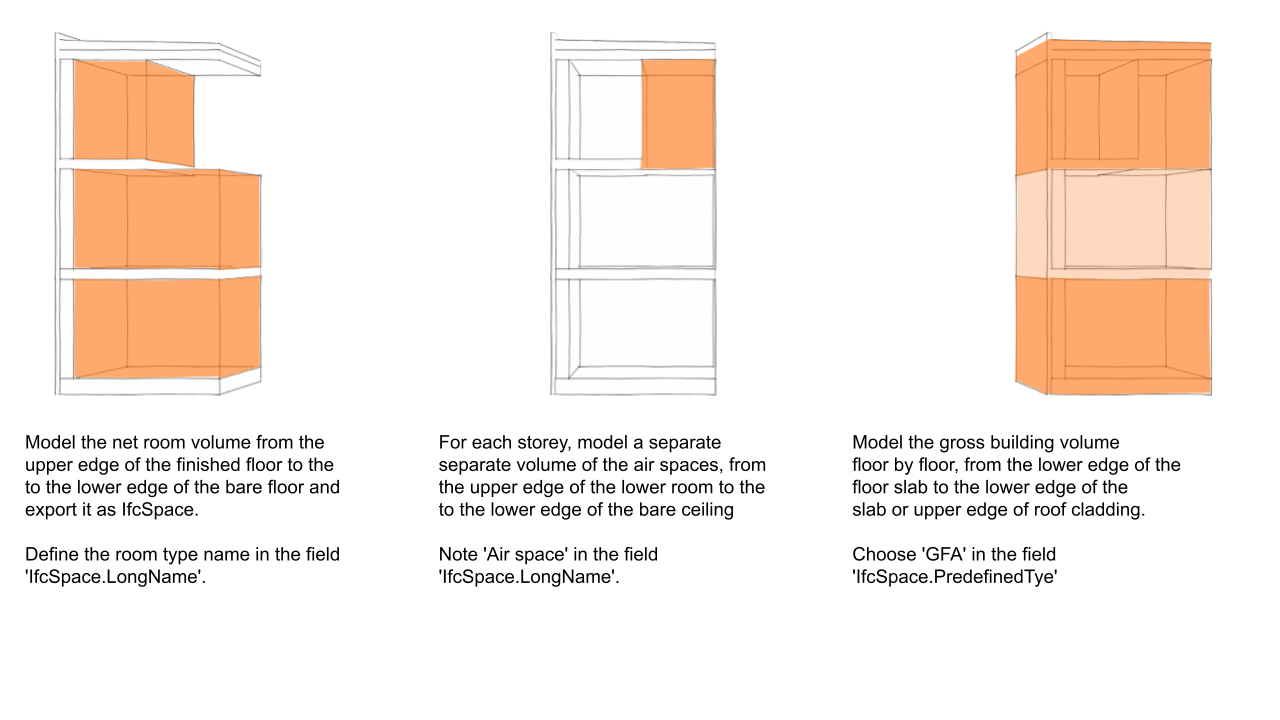
The Window Schedule (IfcWindow): Additionally requesting windows as explicit IFC components allows clients to extract the precise glazing-to-wall ratios required for early energy and sustainability reviews.
3. Centralized Auditing with abstractBIM
Instead of demanding that 100 individual architectural offices run disparate, non-comparable energy and cost calculations on their own models, all simulations, analyses, and benchmarking should be centralized entirely on the client side. This approach guarantees true objectivity across every entry.
By utilizing data science platforms like abstractBIM, competition organizers can ingest raw, unstandardized room cube models and instantly run automated pipelines for:
- Area Analysis & Benchmarking: Automating comparisons of usable floor areas against circulation zones across dozens of submissions simultaneously.
- Target Cost Calculations: Extracting rule-based volumetric quantity takeoffs (QTO) to identify early financial and budgetary risks.
- Energy & Thermal Simulations: Converting spatial geometry blocks directly into simulation-ready schemas for rapid environmental validation.
- Life Cycle Cost (LCC) Forecasting: Evaluating long-term economic and sustainable performance profiles before awarding a final prize.
4. The Three Levels of Digital Competitions
The industry's transition from traditional documentation to digital screens is an ongoing evolution. Competition layouts generally fall into three operational categories:
- Mini: Traditional physical submittals accompanied by a digital room model (IfcSpaces) explicitly utilized for automated technical compliance checks. This represents the lowest entry barrier for hybrid workflows.
- Midi: Hybrid submittals where the digital models are actively introduced into the jury room to support design decision-making.
- Maxi: Zero physical deliverables. The entire judging panel relies on digital screens, interactive visualization matrices, and virtual reality (VR) environments to award the project.
Visualizing the Unseen: The Flip Model
Digital models excel at pedestrian perspectives, whereas physical plaster models offer immediate, simultaneous orientation. An elegant compromise highlighted by architect Wolfgang Rossbauer is the "Flip Model".
While traditional models show only above-ground urban settings, flipping the model reveals the underground excavation and substructure framework. This provides juries with a clear view of the project's true subterranean structural and environmental footprints.